Overnight session · 5 minutes
Trades the Asian and European session of the Nasdaq, 6:00 pm to 8:00 am New York time. Reversal entries with a fixed target of twice the risk. No open positions during the 8:30 am data release.
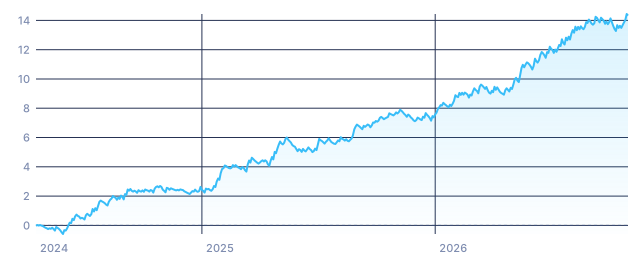
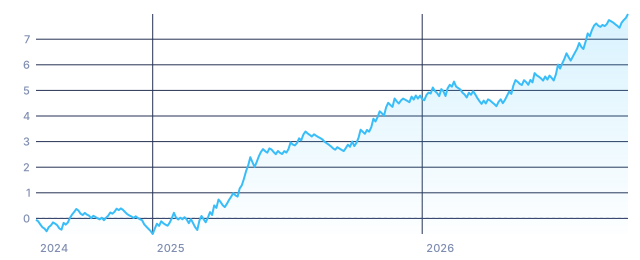
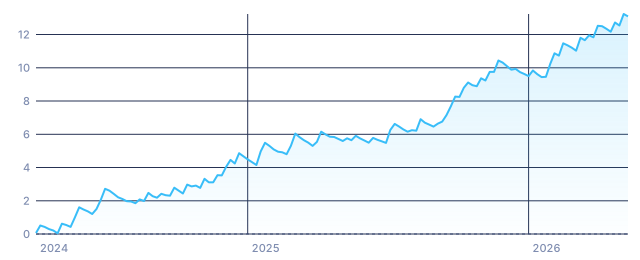
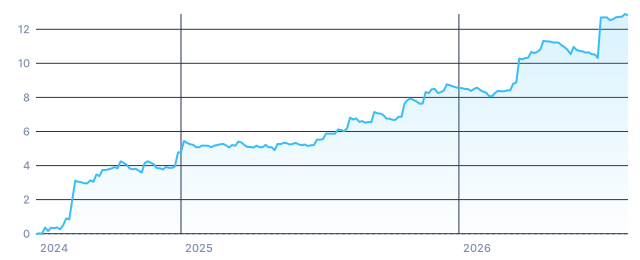
Four closed systems, validated on 27 months of one-minute data and designed from day one around the trailing drawdown, the daily loss limit and the consistency rule of 50K accounts.
Traders with an evaluation or funded account who want a systematic approach, with risk bounded by design, without sitting in front of the screen.
Each system sizes positions per $1,000 of maximum allowed loss. The system's historical drawdown stays well below the account limit.
A configurable daily cap inside the system itself: once reached, it stops sending orders until the next session. It does not depend on the trader watching.
Uniform position size and fixed time windows. No single day depends on one oversized trade, which is what breaks the 40 % rule.
Each one trades a different window of the Nasdaq session with a different logic. They can be combined in the same account: the windows are designed not to overlap. Entry logic is not published.
Trades the Asian and European session of the Nasdaq, 6:00 pm to 8:00 am New York time. Reversal entries with a fixed target of twice the risk. No open positions during the 8:30 am data release.
Trades the middle of the US session, 11:00 am to 2:00 pm New York time, in the direction of the intraday structure. Stop equal to the signal bar range, target of twice the risk.
Entries only during the first half hour of the US session, with the opening momentum. Wide target and exit on structure change. Few, highly selective trades.
A 15-minute reversal pattern with context confirmation, traded across the full session. Dynamic exit on trend change instead of a fixed target. Long side only.
"Max DD vs. allowed": the system's historical maximum drawdown, at the recommended size, as a percentage of the $2,000 maximum loss of a 50K account. "Trades / month": trades per month over the test period. All figures come from simulation, not from live accounts.
A nice backtest is not evidence. Every system goes through the same tests, in the same order, and only goes live if it passes all of them. The ones that fail are archived with their report; dozens of ideas have been discarded by this process.
Rules, filters and parameters are written down and sealed before the first test runs. Whatever was not in the specification is not measured afterwards "to see if it improves".
One-minute bars of the real contract, with commission and one tick of slippage per side. Higher-timeframe bars are built from the minute, exactly as the platform sees them.
The same signal traded on the opposite side. If the mirror earns a similar amount, the system has no direction: it only collects or pays the cost. The mirror is required to lose.
Hundreds of random subsets of the same universe of bars. The system must sit in the upper tail of that distribution; if any random selection matches it, the filter selects nothing.
Data through 2025 is used to calibrate; 2026 is reserved for confirmation. A system whose edge disappears in the confirmation window does not pass.
Thousands of paths by resampling weeks, applying the trailing drawdown, the daily limit and the consistency rule of the account. The probability of passing the evaluation and of blowing the account is measured.
The test engine is checked trade by trade against the code running in NinjaTrader. What the lab measures is what the platform executes.
Every live trade is matched with the replica: same time, same side, same risk. Deviations are investigated and documented. Changes only go in with a measurement in their favour, never because of two bad trades.
Everything a prop firm demands from the trader is inside the code. Nothing to remember and nothing to watch during the session.
Signals whose stop exceeds the configured cap are discarded and logged with the reason.
Once reached, the system stops trading until the next session. Independent for each instance and each account.
No entry outside the system's window; forced close before the end-of-session time set by the firm.
Option to close ahead of scheduled macro releases, to avoid gaps through the stop.
A daily file with every signal sent or discarded, orders, fills and connection state.
Each instance confirms every hour that it is alive, receiving bars and what position it holds.
If the platform stops receiving bars with the market open, the system detects it and reports it.
An external process that checks every instance and sends Telegram alerts when something is not where it should be.
One-time payment. Each license is tied to one machine and one account number, and includes twelve months of updates and email support. The number of licenses per system is limited so that too many accounts do not concentrate on the same trades.
Digital product: once the license is delivered there is no refund. Before delivery, the buyer's platform, data feed and account are checked for compatibility. Prices exclude taxes; applicable taxes are added according to the buyer's country.
Licenses are assigned in order of request, with a maximum number per system. State your platform, account size and the system you are interested in. Reply within 48 hours.
info@tradervolume.com
The form opens your email client with the details filled in. Nothing is stored on this site.
Trading futures and CFDs involves a high risk of loss and is not suitable for every investor. You may lose all of the capital deposited or the full cost of a funded-account evaluation. Past results, whether real or simulated, do not guarantee future results.
The figures and curves shown on this site are hypothetical results obtained by simulation on historical data. Simulated results have inherent limitations: they do not represent actual trading, they do not fully reflect the impact of liquidity, slippage or execution under real conditions, and they were obtained with the benefit of hindsight. No representation is being made that any account will or is likely to achieve results similar to those shown.
TraderVolume sells software. It does not provide financial advice or portfolio management, does not recommend specific trades and is not registered as an investment adviser. The decision to trade, and its consequences, rest solely with the buyer. Read the full disclaimer.